Choosing accessible stays, parking and boat trips in Halkidiki
Halkidiki can be wonderfully easy with limited mobility, but only if you ask the right questions before you book. From hotel entrances that look flat in photos to marinas with long ramps and awkward boarding, the details matter.
We are Halkidiki.info – travel guide for Sithonia, Kassandra & Mount Athos, a local Thessaloniki and Halkidiki team with over 20 years on the ground. We have stayed in these areas, parked in the same spots, and joined the same boat days out many times, so this is the practical stuff that saves your energy.
First, pick the right base (it makes everything else easier)
Halkidiki is three peninsulas. Kassandra is generally the easiest for shorter drives and more developed promenades. Sithonia is prettier and wilder, but the hills and beach access can be more work. The Athos Coast has lovely calm coves, yet it can feel more spread out.
If you want a simple, practical base with lots of services, look at Neos Marmaras in Sithonia or the busier resort areas in Kassandra. If you want a traditional village feel with amenities close by, Afytos can work well, but note the old village streets are steep in places and not every route is step-free.
For a broader picture of terrain, gradients, and what daily life feels like here, this guide helps: Halkidiki with Limited Mobility: Overview, Terrain and Everyday Practicalities in 2026.
How to reach Halkidiki with fewer hassles
By car from Thessaloniki
Driving is usually the smoothest option because you control stops, shade, and timing. From Thessaloniki you are typically looking at roughly 1 to 2 hours to many resorts, depending on peninsula and traffic. In summer, aim to travel earlier in the day, because midday arrivals can mean circling for parking in the heat.
By bus (KTEL)
If you rely on public transport, start at the KTEL Halkidiki Bus Station in Thessaloniki (Pylaia). Accessibility can be ok, but it depends on platform, bus type, and staff support on the day. Ask in advance about boarding help and luggage handling. Also, plan your transfers so you are not forced into a long walk from a drop-off point to your accommodation.
Timetables, opening hours and routes can change without notice. Always double-check locally before you travel.Medical reassurance
Most people never need it, but it is calming to know where the main services are. The General Hospital of Halkidiki is in Polygyros, inland. If you are choosing between two bases, being closer to a main road route back towards Polygyros and Thessaloniki can be a quiet comfort, especially for older travellers.
Choosing accommodation: what to ask (and how to word it)
Photos rarely show the one step at the entrance, the steep driveway, or the lift that starts after a short staircase. When you message a hotel, keep it specific and ask for measurements and photos. If you only ask “Is it accessible?”, you will often get a polite “yes” that means “we have a ground floor room”. Not the same thing.
The essential questions (copy and paste)
- Entrance and route: “Is there a step-free route from the street or parking area to reception and to the room? Please confirm if there are any single steps anywhere on the route.”
- Lift details: “If there is a lift, does it start at ground level with no steps? What are the lift door width and cabin size?”
- Room access: “Is the room door wide enough for a wheelchair or walker? Can you send a photo of the door and threshold?”
- Bathroom reality: “Is the shower walk-in with no lip? If there is a lip, how high is it? Are there grab rails and where exactly?”
- Bed height and space: “What is the bed height from floor to mattress top? Is there clear space on both sides of the bed?”
- Balcony and terrace: “Is there a step to the balcony? How high is the track?”
- Pool and restaurant: “Is the breakfast area step-free? Are there ramps? For the pool, are there steps with a handrail or a hoist?”
- Beach access: “How far is it from the room to the beach entrance, and is the route flat? Is there a boardwalk on the sand in summer?”
Ask for the right proof
It is completely normal to ask for two or three quick phone photos. Ask for the entrance, the bathroom shower, and the route from parking to room. A good property will not be offended. If they avoid answering or keep replying with vague lines, that is a sign to move on.
Accommodation features that actually help in Halkidiki
- Ground-floor rooms with a genuinely flat path, not “ground floor” reached by steps.
- On-site parking with enough width to open doors fully. Tight courtyards are common.
- Shade close to the entrance. Waiting in the sun is what drains people.
- Walkable evening options nearby, so you are not doing extra car trips.
Where it tends to be easier
In Kassandra, areas around organised resorts and marinas often have better surfaces, lighting, and parking management. In Sithonia, Neos Marmaras has lots of choice, and being close to a marina can make boat days much simpler. If you are looking at Afytos, aim to stay on the edges of the village or closer to the beach level, because the old centre can be a leg-burner even for fit visitors.
Parking in Halkidiki: angles, surfaces and the small stuff that matters
Parking is not just about finding a space. It is about being able to get out of the car safely, without traffic brushing past your door, and without a sloping surface that makes transfers harder.
What to look for when you arrive
- Angle: Avoid steep camber and sloped roadside bays. If the ground falls away on the passenger side, getting out can feel sketchy.
- Surface: Gravel looks charming but can be a pain with wheels and walking aids. Smooth tarmac or paving is kinder.
- Space width: End bays are gold. So are spots next to a wall on one side, if the other side gives you room to open wide.
- Shade: In July and August, a shaded space can be the difference between a calm day and a sweaty struggle.
- Distance: A slightly longer walk on a flat route is often better than a short walk on a steep one.
Common local parking situations (and how to handle them)
In busy villages, you will see informal parking on the edge of the road. If you have limited mobility, skip it when cars are flying past and go for a proper lot, even if it means arriving earlier. At beaches, many car parks are compacted dirt. After a storm, ruts appear and it gets messy, so keep an eye on the ground before you commit. Some people get stuck simply because they parked nose-down in soft sand and cannot reverse out easily.
We have a dedicated, very practical guide for the two main peninsulas here: Where to Park in Kassandra and Sithonia Without Getting Stuck or Fined. It includes the sort of details you only learn after a few summers of doing it wrong.
Marina parking tends to be the easiest
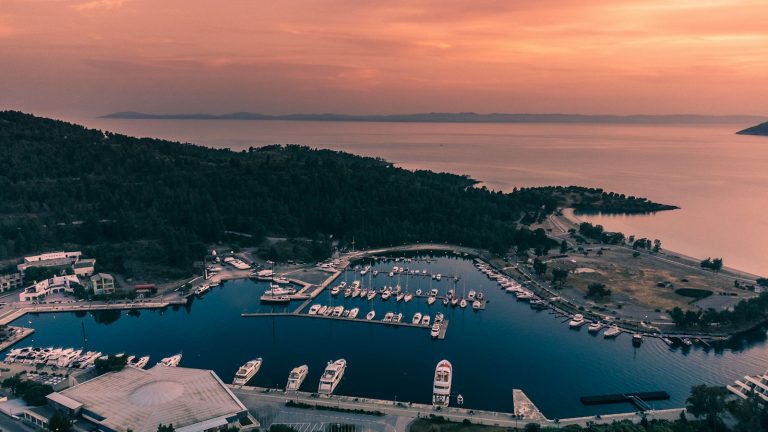
If a boat trip is a priority, consider choosing a base near a marina with proper facilities. Sani Marina in Kassandra is generally orderly and designed for foot traffic. In Sithonia, Porto Carras Marina near Neos Marmaras is a solid option with a more structured layout. Latoura Marina by Ormos Panagias is another key departure point, often with straightforward access for day trips.
[random_authority_text]
Boat trips with limited mobility: what “accessible” really means on the water
Let’s be honest. Most boats in Greece are not purpose-built for wheelchair access. That does not mean you cannot enjoy a brilliant day at sea. It means you need to choose the right style of trip and ask the operator very direct questions.
Step-free choices that tend to work best
- Larger day boats and motor yachts from marinas where boarding is from a stable pontoon, not from a beach.
- Small-group sailing with a calm boarding set-up, especially if the crew are used to helping and the group size is limited.
- Private or semi-private trips where the pace is slower and you can avoid the rush at boarding time.
Trips that are often harder
- Beach boarding by stepping through shallow water, especially with pebbles and waves.
- Boats with narrow companionways and steep steps to the toilet.
- Very long itineraries with lots of swim stops if you need frequent shade, seating, or easy toilet access.
Questions to ask boat operators (wording that gets real answers)
- “Is boarding from a pontoon at the marina, with no need to step into the sea?”
- “How many steps are there from the dock onto the boat, and is there a handrail?”
- “Is there a toilet on board, and does it require going down steps? Please describe the stairs.”
- “Can you confirm there is a shaded seating area available for the whole trip?”
- “If someone cannot swim, is it still enjoyable? Are there calm stops where we can stay on board comfortably?”
- “How do you handle boarding support? Do crew assist with steadying and bags?”
- “What is the sea usually like on your route in the afternoon? Do you change plan if the wind picks up?”
Local marinas that make life easier
From Neos Marmaras, departures linked to Porto Carras Marina can feel more controlled and comfortable, especially for first-timers. Latoura Marina (near Ormos Panagias) is another practical start point for Sithonia and Athos-view cruises, because you begin from a marina environment rather than a beach.
In Kassandra, Sani Marina is one of the easiest places to arrive, park, and board without chaos. It is not the only option, but it is a good benchmark for how smooth a marina day can feel.
A note on specific operators
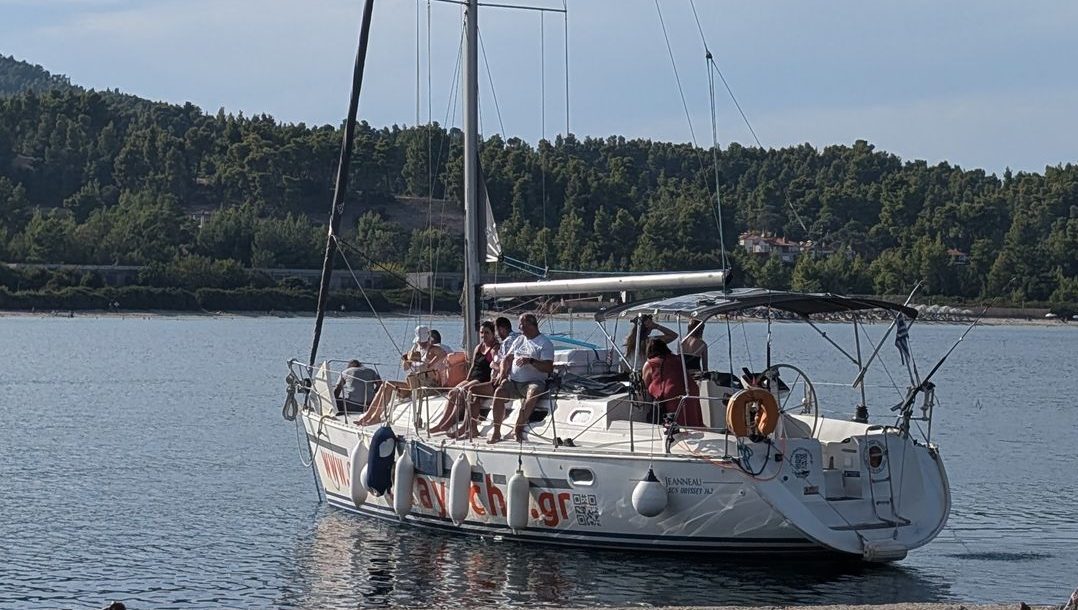
For Neos Marmaras, CharerAyacht Day Sailing & Luxury Motor Yacht Chalkidiki Boat Tours is one example of an operator working from a proper town base where you can discuss needs before you step aboard. Still, always ask the exact boarding set-up for the specific boat on the specific day, because fleets change and so do conditions.
If sailing is on your wish list, you might also like: Why a Small-Group Sailing Trip Is the Best Thing to Do in Halkidiki in 2026. It explains why small groups can be calmer, kinder, and easier to manage.
Choosing between shorter and longer trips (energy matters)
A common mistake is booking the longest trip because it sounds like better value. If you are managing pain, fatigue, or heat sensitivity, a shorter trip can be the better day overall. You still get the water colour, the breeze, and that feeling of being properly away from the road.
Here is a helpful comparison if you are deciding: 3-Hour vs 5-Hour Sailing Trips in Halkidiki: Which Should You Choose?.
What to consider beyond duration
- Toilet access: If the only toilet is down steep steps, a shorter trip may be more comfortable.
- Heat and shade: Midday sun on the water is stronger than people expect. Shade is not optional, its essential.
- Sea state: Afternoon winds can pick up, especially in open stretches. A morning departure is often gentler.
- Boarding and disembarking: Doing it once is fine. Doing it multiple times at swim stops can get tiring.
Beaches and promenades: realistic accessibility in popular spots
Halkidiki beaches vary a lot. Organised beaches in busy areas usually have easier access, sometimes with wooden walkways laid down in peak season. Quieter coves can be stunning but involve steps, uneven rock, or a sandy track. Choose the day based on energy levels, not just Instagram.
Afitos Beach in Kassandra is a good example of a popular spot where you can combine a beach day with facilities nearby, though the vertical difference between the old village and the beach area can catch people out. Neos Marmaras has a mix of flatter routes around the town and steeper bits as you climb away from the waterfront, so where your hotel sits matters a lot.
[beach_map]
Small beach-day tips that help a lot
- Arrive earlier for closer parking and calmer water.
- Pick one base beach for the day rather than hopping between three. Less stress, more sea.
- Bring a lightweight folding seat if standing is difficult. Some beach bars are helpful, some not so much.
- Ask staff where the flattest entry is. Even on the same beach, the slope changes.
Seasonal feel: crowds, wind, water clarity
May and June often feel easiest for accessibility. Less traffic, more parking options, and the heat is manageable. Water clarity is usually lovely, especially after a few calm days. September can be brilliant too, warm sea and a softer pace, though daylight is shorter.
July and August are vibrant and fun, but you need a plan. Parking fills early, pavements get busy, and the sun is intense. If you travel then, build in longer breaks and choose trips that guarantee shade and a simple boarding process.
For official local travel info, the Greek National Tourism Organisation is a good starting point: https://www.visitgreece.gr/. For a quick look at regional weather patterns, you can check the Hellenic National Meteorological Service: https://www.hnms.gr/.
Planning checklist: the three messages that save you from a bad booking
1) To a hotel
“Hi, we are travelling with limited mobility. Please confirm a step-free route from parking to reception and to the room, and send photos of the entrance and bathroom shower. Also confirm if the lift starts at ground level with no steps. Thanks so much.”
2) To a marina or boat operator
“Hi, can you confirm boarding is from a stable pontoon at the marina, not from the beach? How many steps onto the boat, and is there a toilet that does not require steep stairs? We would also need guaranteed shade seating.”
If you want us to sanity-check your plan or help you choose a departure point that fits your needs, send a note here: Not sure where to start? Contact our local travel agency for friendly, personalised advice, seasonal offers and travel options..
3) To yourself, the night before
- Do we know exactly where we are parking?
- Is there a step-free route from parking to where we need to be?
- Have we planned shade, water, and toilet breaks?
One useful scuba and sailing note (for confident travellers)
If diving is on your list and you want to understand what is realistic with mobility limits, start with an experienced local centre and discuss entry methods, boat ladders, and kit handling. You can read more about options and planning via portoscuba.com. For sailing and yacht-style days, browsing trip formats and what “comfort” looks like onboard can help at yachts.holiday.
When you are ready to book a sea day, you can also use:
Helpful local references (worth checking before you go)
- Halkidiki area overview on Wikipedia for geography and town names: https://en.wikipedia.org/wiki/Chalkidiki
- Municipality pages can be useful for local works and access updates, especially in bigger towns. If you are staying in Neos Marmaras, look for Sithonia municipality announcements.
If you want the bigger picture of routes, bases, and what to prioritise day by day, this is the best place to continue: Want the full picture? Read our in-depth Halkidiki travel guide before you book.